
English| EUR
Suggested for you
More currencies
Choose a language
The Parte Vieja packs more bar counters into a few blocks than almost anywhere in Europe, and not one of them takes a reservation for a standing spot. This San Sebastian pintxos tour self guided guide explains how the quarter actually works: free entry, per-pintxo payment at each bar, txakoli poured at the counter, and the daily rhythm that decides what is fresh. Read it before ordering a first gilda.
Quick answer
A self-guided pintxos tour costs nothing to begin: entry to the Parte Vieja (Old Town) is free, at 0 EUR, and pintxos are paid for individually at each establishment. Bars in the quarter run 11:00–23:59 daily, though counters are fullest and rotations freshest between 12:30 and 22:00. No ticket, no booking and no fixed route are required.
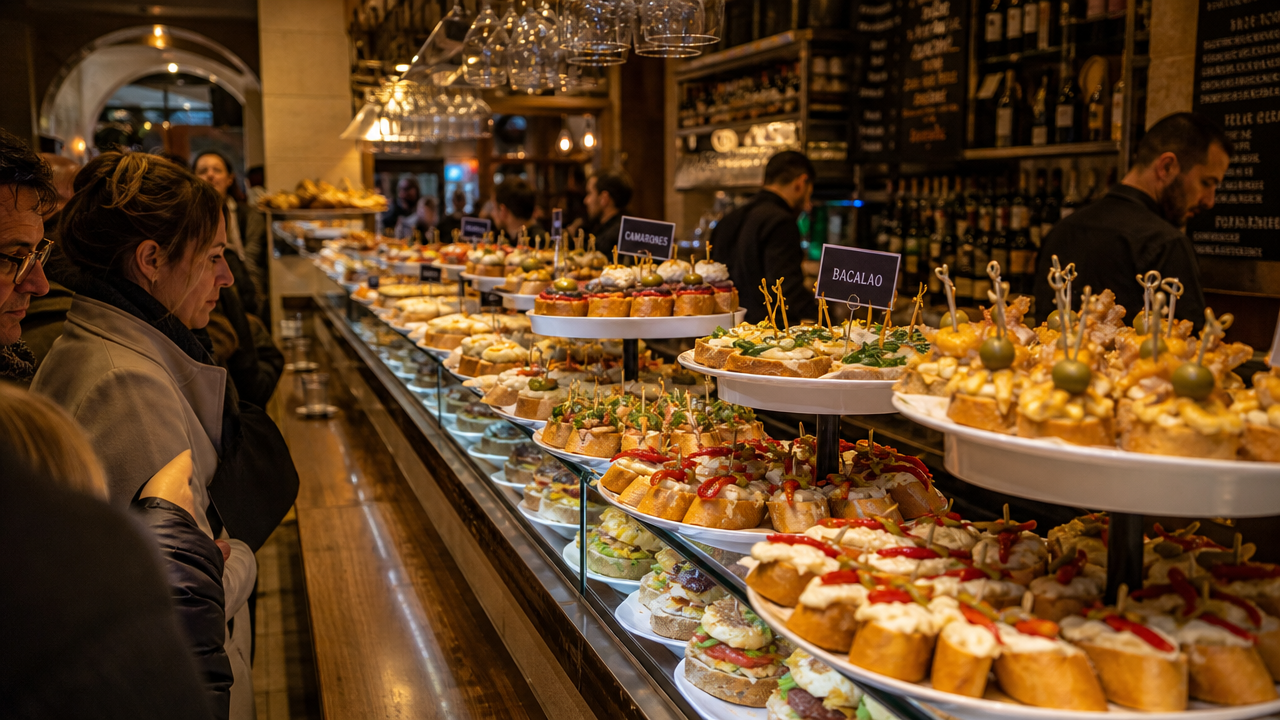
The gilda — a skewer of green olive, anchovy and pickled guindilla pepper — took its name from a 1946 Rita Hayworth film and is still assembled by hand in bars near Calle Reyes Católicos. It predates almost every guided food walk in the city by half a century. That is the useful context for anyone weighing a San Sebastian pintxos tour self guided against a hosted one: the tradition was never curated for visitors. It grew out of drinkers moving between counters in the Parte Vieja, taking one bite and one small glass before stepping back into the street. The Old Town covers only a few walkable blocks, which is exactly what makes it disorienting. Bars crowd the grid between Plaza de la Constitución and Calle 31 de Agosto, the lane that survived the 1813 fire, and each keeps its own rhythm. Cold pintxos sit stacked along the bar from opening. Hot ones are cooked to order and chalked on a board behind the taps, which is usually where a kitchen keeps its better work. Txakoli is poured from height into a flat glass; a zurito is a small beer sized for a single stop. Locals call the whole practice a pintxo-poteo, and the point of it is movement rather than settling in. None of this requires a ticket. The Parte Vieja is a public quarter, entry costs nothing, and the only money that changes hands is handed over bite by bite at each counter — the pricing section on this page sets out how that adds up. What an independent walker gives up is translation and access: a Donostia pintxos crawl led by a local shortcuts the chalkboards, the ordering and the elbow work at a three-deep bar. What they gain is control of pace. Planning a San Sebastian pintxos tour self guided comes down to deciding how many stops an evening can reasonably hold, keeping small change on hand, and accepting that counters restock on the kitchen's schedule rather than the visitor's. Anyone who would rather hand the planning to someone else will find guided walks and market-and-cook sessions listed elsewhere on this site. The lanes between La Bretxa market and the foot of Monte Urgull stay open to both kinds of traveller, and the difference between them is mostly a matter of temperament.
“The tradition was never curated for visitors; it grew out of drinkers moving between counters in the Parte Vieja.”
The optimal window for a self-guided pintxos tour is between 12:30 and 22:00, which aligns with peak social hours and ensures access to the freshest pintxo rotations. Visiting within this timeframe allows you to experience the Parte Vieja when bars are most active and the food variety is at its highest.
Mild, 16°C to 21°C
These months offer pleasant temperatures and manageable foot traffic before the peak summer season.
Warm, 18°C to 25°C
Expect significant crowds during this period, particularly in the evenings, due to summer festivals and tourism.
Cooler, 14°C to 20°C
This period balances comfortable weather with a shift toward local, seasonal ingredients in pintxo preparation.
—
Tuesday through Thursday evenings provide a more local atmosphere with easier access to counter space.
Verdict: The best period for a self-guided tour is Tuesday to Thursday between 12:30 and 22:00 during the months of May, June, September, or October.
This plan suits first-time visitors walking the Parte Vieja at their own pace, moving between four or five bars rather than trying to cover the whole quarter. Allow roughly five to six hours end to end, with breaks built in.
Arrive in the square, get your bearings and note the numbered balconies from its bullring days. Give yourself 20 minutes here before the first bar, since the surrounding streets fill quickly after 13:00.
Order one pintxo and one small drink standing at the bar, then move on. Twenty to thirty minutes per bar is the local rhythm — lingering longer means you will taste far less.
Walk the two minutes to the street that survived the 1813 fire, where several kitchens focus on hot pintxos cooked to order. Expect a short wait while yours comes out.
Step out to the fishing harbour below Monte Urgull for 45 minutes of fresh air. This break resets your appetite before the evening rotation.
Return uphill through the market's edge and try a bar you walked past earlier. Quieter mid-afternoon, so it is easier to ask what the house specialty is.
Finish near the Basílica de Santa María del Coro as trays are restocked for the night. Standing room tightens after 20:00, so choose bars with an outside ledge.
There is no cost to enter the establishment areas, as a self-guided pintxos tour takes place in public spaces. You pay individually for food and beverages at each stop.
Verdict: An adult typically spends between 5 EUR and 9 EUR per stop, depending on the number of items and drinks ordered.
The Parte Vieja (Old Town) serves as the heart of the San Sebastián pintxo scene. It is located at the base of Monte Urgull and is best accessed by public transport or on foot from the city center.
Dbus lines 5, 8, 9, 13, 21, 25, 26, 28 to Boulevard stop
Euskotren to Amara-Donostia station
From San Sebastián city center/La Concha beach
Drop-off at Boulevard or Alameda del Bulevar
The most efficient way to reach the area is via the Boulevard bus stop, which places you at the edge of the Old Town. If arriving by car, note that street parking is limited and paid; use designated underground parking garages such as Okendo or Boulevard.
Pintxo bars in the Parte Vieja run on trust and speed, and locals notice when visitors break the rhythm. Knowing how to order, pay, and move on keeps the counter flowing for everyone.
Everything you need to know about san sebastian pintxos tour self guided
A self-guided exploration involves walking between various taverns in the Old Town to sample small snacks. You simply enter a bar, order a drink, choose your desired bite from the counter, and pay individually at each location.
No advance booking is required because these establishments operate on a walk-in basis. You have the flexibility to curate your own path through the city's culinary landscape at your own pace.
There is 0 EUR entrance fee for these establishments. You only pay for the specific food and beverages you consume at each stop.
The best arrival window is 12:30–22:00 to avoid mid-day heat and align with peak social hours. This timing ensures you experience the most frequent rotations of fresh, seasonal tapas.
Yes, children are welcome in most bars, though the spaces can become quite crowded during peak hours. It is often easier to visit earlier in the afternoon when the venues are less congested.
Many visitors make the mistake of staying at the first bar they find rather than moving on. The core of this experience is sampling one signature specialty at several different venues to appreciate the local gastronomy.
How to Eat Pintxos in San Sebastian
Read more GuideSan Sebastian Pintxos Prices & Costs
Read more GuideLocal Tips for Pintxos Bars
Read more GuidePintxo Pote: The Thursday Tradition
Read more Tickets & toursPrivate Pintxos Tours
Read more Tickets & toursEvening Pintxos & Wine Tours
Read more