
English| EUR
Suggested for you
More currencies
Choose a language
In the Parte Vieja, the bar counter is the menu and the toothpick is the receipt. This San Sebastian Pintxos Prices guide explains how the Basque counter system works, what shapes a bill in Donostia, and where the real cost of an evening comes from.
Quick answer
Bars across the Parte Vieja run daily, and counters are at their fullest between 12:30 and 21:00, when turnover keeps the food fresh. Cost therefore depends entirely on how many you order.
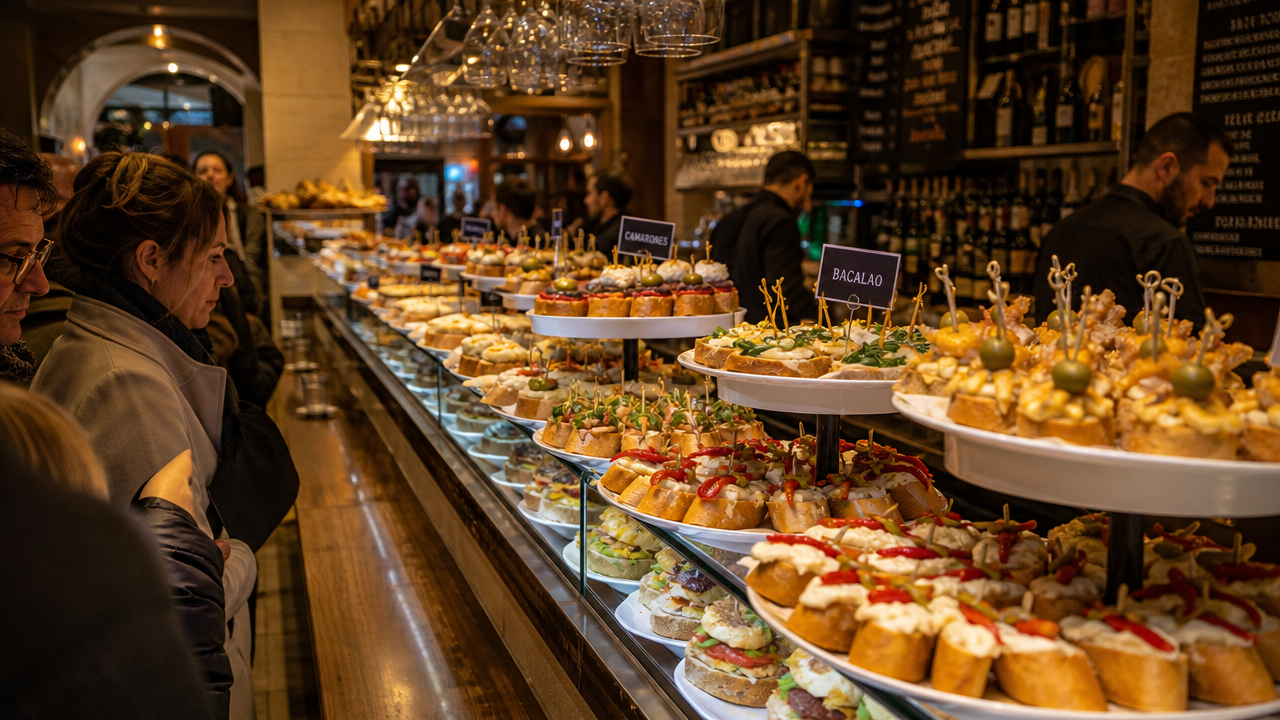
San Sebastián counts more Michelin stars per head of population than almost any city on earth, yet the meal that defines it is eaten standing up, in a couple of bites, at a crowded bar. That contradiction is the first thing to understand about San Sebastian pintxos prices. There is no admission charge and no set menu. Every establishment in the Parte Vieja is free to walk into; the bill accrues one toothpick at a time, and the total depends on appetite rather than on any published tariff. The mechanics are local and consistent. Cold pintxos sit on the barra under glass or open to the room: gildas of olive, anchovy and guindilla pepper; slices of tortilla; bread topped with jamón or bacalao. Hot pintxos, the cazuelitas, are cooked to order and listed on a board behind the counter, usually in Basque and Spanish. Drinks follow the same logic. A zurito of beer, a glass of txakoli poured from height, or a small red — the pour is deliberately modest because nobody stays long. Regulars order one bite and one drink, settle up, and move to the next door. That circuit has a name in Donostia: the txikiteo, or poteo, and it shapes the arithmetic of any pintxo crawl budget. Geography matters more than menus. The densest stretch runs along Calle 31 de Agosto and Calle Fermín Calbetón, the two arteries of the Old Town, where bars stand shoulder to shoulder within a few minutes of La Concha and the harbour. Across the Urumea river, Gros keeps a quieter, more residential rhythm around Calle Zabaleta. What visitors are really deciding is not what each item costs but how many bars to attempt, in what order, and at what hour. Kitchens restock in waves; a counter picked over in mid-afternoon looks different at dusk. Reading the room is the skill this city rewards. Newcomers who want the sequence solved for them tend to join a guided San Sebastián pintxos tour, where a local leads the route and orders the house speciality at each stop. Those who prefer to improvise should treat San Sebastian pintxos prices as a running tally rather than a fixed sum, and set a limit in bars visited instead of euros spent. Either way, the accounting is honest: point, eat, count the toothpicks, pay, and walk on.
“The bill accrues one toothpick at a time, and the total depends on appetite rather than on any published tariff.”
Exploring the culinary scene in the Parte Vieja, San Sebastián, operates on a pay-per-item basis. There are no fixed entrance fees for individual establishments.
Verdict: A typical visitor pays per item consumed, with the total cost determined entirely by the number of selections and drinks ordered.
The best arrival window for experiencing San Sebastian pintxos is 12:30–21:00. This period ensures access to the freshest food while aligning with the local social atmosphere.
—
Visiting Tuesday through Thursday offers a quieter experience with easier access to bar counters.
—
Expect significant activity and vibrant, crowded bar environments throughout the Parte Vieja area.
Mild 15°C to 22°C
Spring and autumn provide comfortable temperatures for walking between establishments without extreme heat.
Verdict: For the highest quality experience, target a Tuesday to Thursday arrival within the 12:30–21:00 window during the months of May, June, September, or October.
Pintxo bars in the Parte Vieja run on trust and quick turnover, so how you order, settle, and move through a crowded counter matters as much as what you eat. Getting the rhythm right marks you as a guest who respects the local social environment rather than a bottleneck at the bar.
Everything you need to know about san sebastian pintxos prices
When considering san sebastian pintxos prices, expect to pay per individual item consumed rather than a flat rate. Most small bites range in cost depending on the ingredients and preparation method. It is helpful to carry small denominations of cash for convenience.
While san sebastian pintxos prices are very reasonable, a full meal at a sit-down restaurant usually involves a higher fixed cost. Sampling several small bites at different bars is often more cost-effective and provides a broader culinary experience. This approach is a hallmark of local food culture.
When navigating the culinary landscape, remember that bars are often crowded and service is fast-paced. It is customary to order a drink alongside your snacks and move on to the next location after a short stay. Keeping your order simple helps maintain the flow for other patrons.
You will find that the costs for a gourmet walking experience are quite accessible for most travelers. While planning your san sebastian pintxos tour, remember that the total spend depends entirely on your personal appetite. Many visitors enjoy the ability to control their budget by choosing how many items to consume.
Most establishments accept card payments, but carrying some cash is useful in smaller, traditional spots. Once you finish your selection, you can pay at the counter before heading to your next destination. This straightforward process makes it easy to explore multiple landmarks in the old town.